Mazda CX-5
Mazda finally fixed the chassis. The segment moved on.
Four reviewers confirm the multi-link rear, the MX-5-inspired tuning, the anti-mushy ride. Three of four find a way to say it doesn't pick the car anymore.
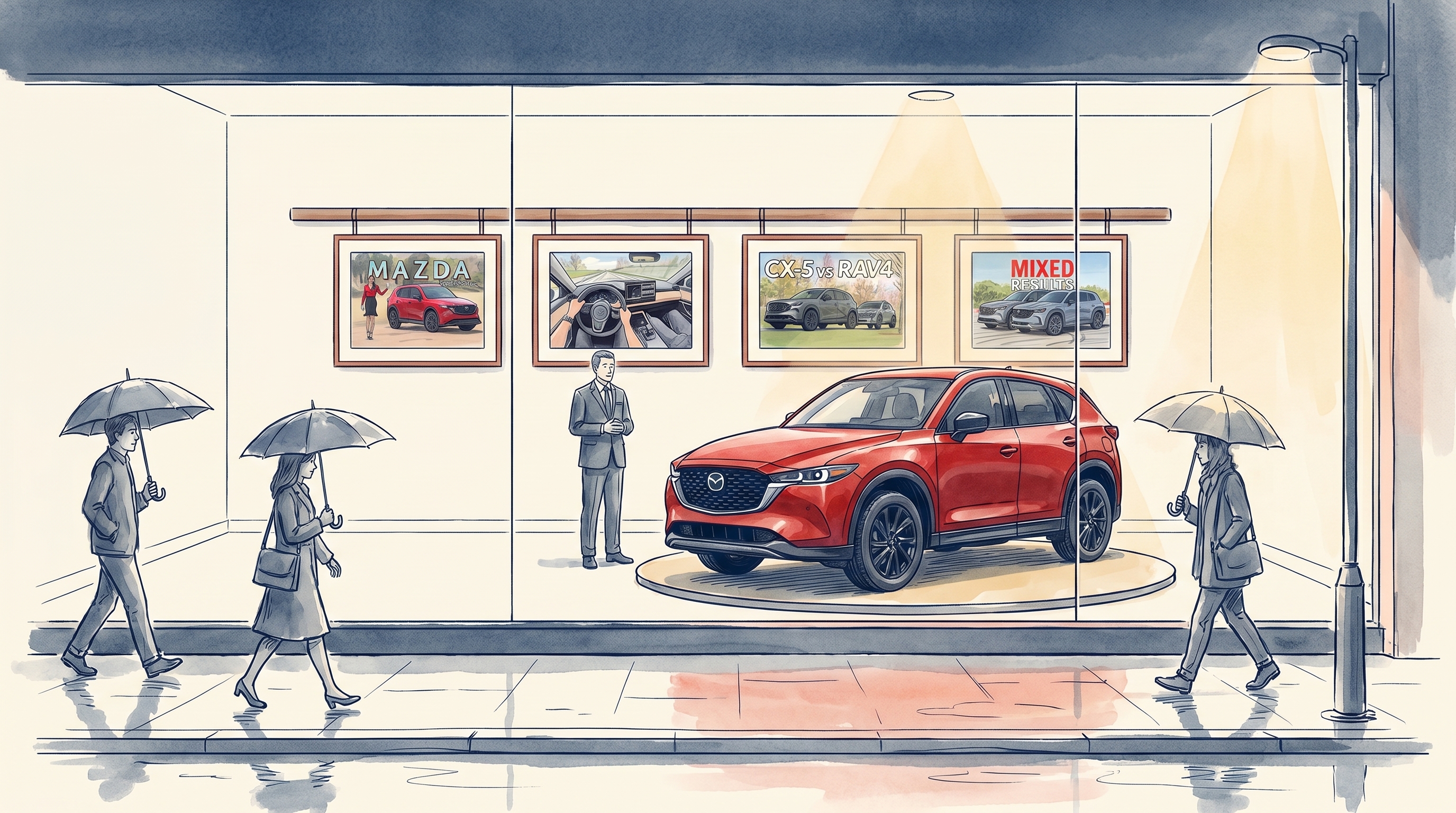
The 2026 Mazda CX-5 finally has the multi-link rear suspension a Mazda is supposed to have. On the lift, on the road, head-to-head with a CX-50, head-to-head with a RAV4 — four reviewers this week verify it. Three of the four concede, in the same breath as the praise, that the dynamic case is no longer what picks the car. Mazda fixed something the segment stopped grading on.
On the lift
Sarah -n- Tuned puts the CX-5 on a four-post and starts pointing. Multi-link rear with cast-iron knuckles. ZF coilover dampers, divorced springs, sourced from South Korea. A 19mm anti-sway bar above the subframe. The CX-50, built for the US on the Mazda 3 platform, uses a torsion beam. The CX-5 doesn't. On the road she names what those torsion-beam Mazdas had been missing — "the connection to the road feel" — and this one no longer skips like a rock on a pond.
What got cut
That's the half the panel agrees Mazda got right. The other half is what TheTopher catalogs for most of his airtime. "There are two ways to change gear manually in this car. Both physical buttons. Zero ways to adjust volume physically." No volume knob, no mute, no ledge for the touchscreen. Sarah -n- Tuned watches voice control fail on basic commands and concedes Mazda "fell victim to peer pressure." Savagegeese calls it identity loss. The first leg of Mazda's brand stool was driving feel; the second was the cabin — the round dial, the integrated widescreen, an interior that read a class above the price. The first leg is repaired. The second is gone.
What the segment rewards
Savagegeese takes the CX-5 into the segment's title fight and confirms every chassis claim. "It's a really anti mushy car." Less head-toss than the CX-50, lower-frequency boom controlled better than the RAV4. Then he picks the RAV4. The 2026 RAV4 is hybrid-only — ten real-world mpg up on Mazda's NA 2.5L, higher residuals, three or four grand more out the door but lower to own. It kept physical volume, temperature, and drive-mode buttons. The verdict, in his words: "Mazda's almost overfocus on driving dynamics in vehicles that driving dynamics don't particularly matter in."
An enthusiast defects
Jubbal & Cars has owned a CX-50 Turbo Premium Plus for three and a half years and drives it daily; this is the car the new CX-5 was built to lose to on dynamics. Back-to-back, he confirms the gap, then collapses it. "I'm surprised by how expensive this car feels in the way that it drives." By his own accounting, the new CX-5 is twenty percent less fun and forty percent more comfortable — and over his own car, he takes it. Mazda's enthusiast lost the argument to a Mazda.
This is how a Mazda is supposed to be.
Mazda has lost a lot of their identity in the interior space of this car.
Unless you're a weirdo like me and you love driving, then the CX-50 might still be your pick.
The reviewers, side by side
4 reviewers. 3 questions. Where the arguments overlap and where they diverge.
Wrong leg first
Mazda made a generation of investments in the leg of its brand the segment under-rewards, and let cost-cutting eat the leg the segment grades on. The multi-link rear and the MX-5-tuned damping are not nothing — Jubbal's defection from his own CX-50 is the proof. But the verdict that lands hardest is Savage's, because he confirms the chassis case and votes against it anyway. The 2026 CX-5 is the most engineering-honest Mazda crossover in years, sold to a segment that grades engineering honesty last.
The CX-5 finally drives like a Mazda. The buyer wanted it to drive like a Toyota.