Dodge Charger
Quicker Than a Hellcat. So Where's the Real Charger?
Dodge's 600-hp Super Bee outruns the icon it's measured against — and three launch-day reviews spend their runtime asking after cars that aren't in the room.
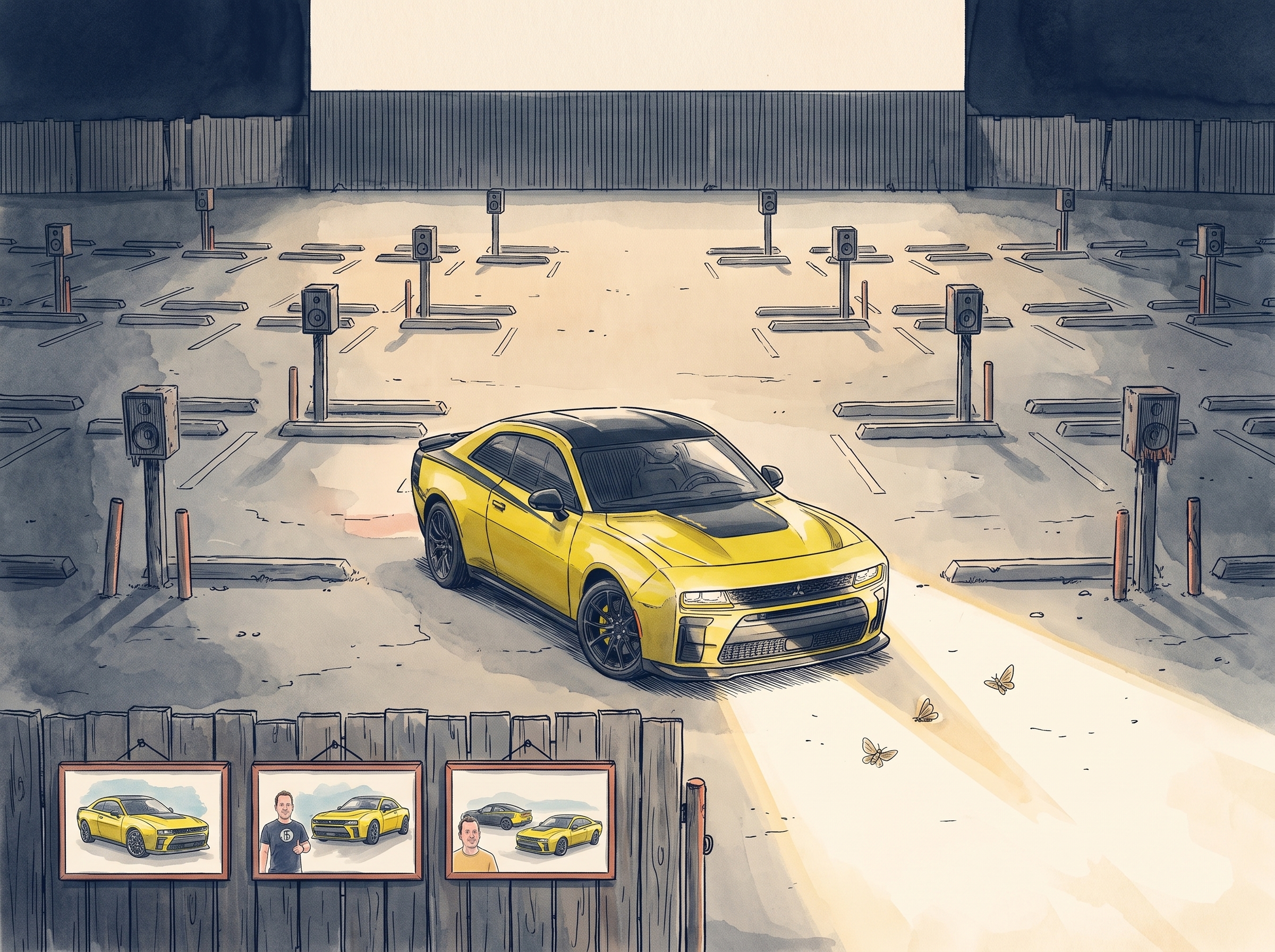
Every review of the 2027 Charger Super Bee opens with the same arithmetic — 600 horsepower, 3.6 to sixty, quicker than a 2015 Hellcat — and the sameness is the tell: the comparison came from Dodge's press kit, not from the three cameras repeating it. Two questions hang over launch day. Does beating an eleven-year-old car actually matter? And if this isn't the real Charger, where is it?
The number everyone recites
As a stat it's unimpeachable; as persuasion it's strange — the benchmark retired in 2015, and the case it makes collapses inside Dodge's own showroom. Raitis Rides relays the number with relish — "Chew on that for a second. Are you done?" — then polls his audience on whether they're still holding out for a Hemi, conceding mid-celebration that the number may not travel. And if speed settled anything, it already would have: the electric Daytona is quicker than this car, today, and the faithful walked past it. Matt Maran Motoring grants it one dry line — "still the king for those who actually care about winning races" — which is the point: apparently, almost nobody does.
The past, painted on
Raitis reads the car through 1968 — birthday cake, party hats, a Super Bee stinger that's painted on rather than stickered, yellow stitching he inspects for corner-cutting and doesn't find. His conviction is the best evidence on the panel that the anniversary theater works: commitment at the level of paint and thread reads, to the faithful, as authenticity. But his hierarchy of wants gives it away — a manual can't even be discussed, he says, until the Hemi comes home. The realest Charger he can imagine is one they stopped building.
The future, arriving eventually
Redline Reviews breaks the no-Hemi news with an actual "sadly," then mounts the numerical defense: 200 horsepower per liter, the most power-dense production muscle car in the world, tuner builds already past a thousand horsepower — "It almost feels like a modern-day version of the 2JZ engine." It's the strongest case anyone makes for the six on its own merits, and he undercuts it in the same breath, relaying that SRT has a V8 version in the works — which quietly recasts this launch as advance press for a different car.
The Charger nobody is building
Matt Maran never mentions the anniversary. His video is a strategy audit wearing a first-look's clothes: genuine surprise at the substance — "I was expecting a sticker package and not much more" — followed by the observation that substance aimed at "a very small sliver of people" moves nothing. His real question is the one no launch event stages: "where are the regular rear-wheel drive versions?" The cheap, high-volume cars that made Charger a household nameplate have no successor here — a great halo product, he allows, hung over an empty lineup.
the tooth fairy would bring you a supercharged Hemi charger, a new one, that's not happening yet
Dodge says that SRT is working on their version as we speak
for many people, this is still not going to move the needle if they're waiting for the V8
The reviewers, side by side
3 reviewers. 3 questions. Where the arguments overlap and where they diverge.
Graded against an absence
The two questions collapse into one. Beating a Hellcat doesn't matter because the needle was never measuring speed — a quicker Charger already sits in showrooms wearing a Daytona badge, and showrooms can't move it. Three answers to the second question — the past in painted stripes, the future in SRT's workshop, the base model nobody will promise — describe a lineup that is all halo and no foundation. The realest Charger is the cheap rear-drive one Dodge isn't building; until it exists, every launch gets graded against an absence.
The fastest gas Charger ever built spent launch day answering for two engines it doesn't have — and one car nobody will promise.