Toyota RAV4
Everyone Called the GR Badge a Story. Everyone Bought One.
Four reviewers pulled apart what Toyota's sportiest RAV4 actually adds, agreed the theater had been faked, and recommended it anyway.
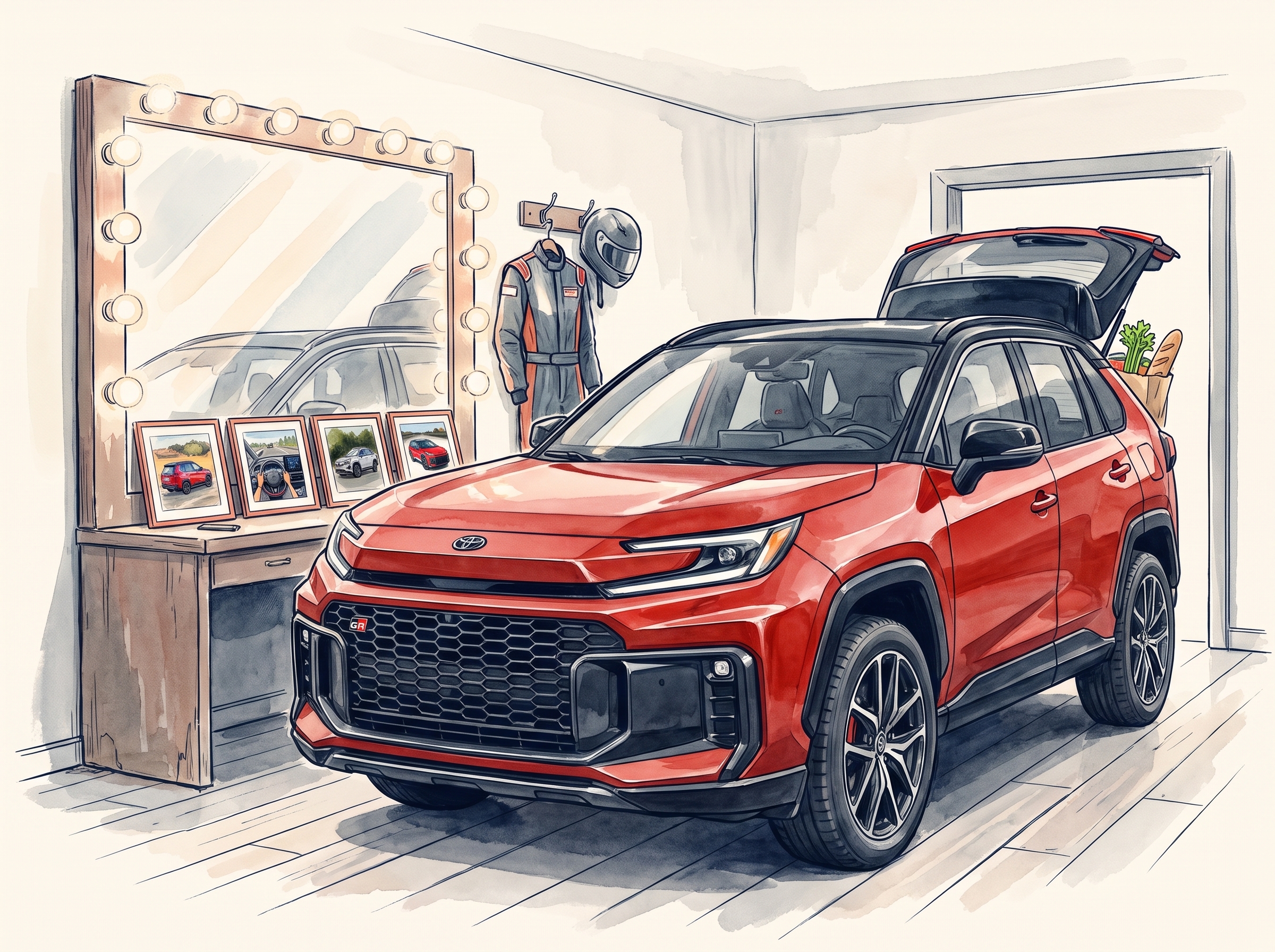
Under the hood of the GR Sport, nothing has been changed from a $41,000 SE plug-in — same 324 horsepower, same e-CVT, same all-wheel drive. Gazoo Racing added suspension, tires, aero, and letters. Four reviewers spent a week each sorting which of those had been earned, and reached broad agreement. Then the most skeptical among them went shopping.
Nobody could find the shift
Where the panel converged most tellingly, they converged against the car. Zygrene spends a straightaway hunting the sequential shift he had been promised — "Where is the shift?" — and comes back empty-handed. Toyota left the engine note untouched as well, which disappoints him precisely because he had spent the previous corner praising how flat the thing stayed. Given the same paddles on an XSE, Brian Makse reaches for a crueler figure: an imitation of an elevator's close-door button. TopherDrives had given up on Toyota's manual mode years earlier. Whatever the sport layer had been meant to simulate, none of the three could locate it.
Then they drove it hard
Driven with intent, the same car turned the same three around. Zygrene had expected a tall crossover to lean and met composure instead — battery mass sitting low, anti-roll bars doing real work, body control he calls deceptive. On his performance loop, Topher runs out of tire long before chassis: "I can tell the chassis has so much more in it." Fifteen millimeters lower, ten wider per side, retuned dampers, a reinforced rear crossmember. Nobody questioned the engineering. They questioned the dressing.
The auditor buys his own story
Makse arrives with the sharpest instrument anyone brought — trim ladders read as narrative pricing, where "it stops being about equipment and starts being a story you tell yourself in the showroom." He runs the horsepower math and catches the industry's rounding: 186 plus 203 makes 389 before the rear motor gets counted, yet Toyota prints 324 on the sticker. He verifies the XSE's extra $10,000 as real hardware. Then, having built all of that, he picks the GR Sport — surrendering DC fast charging and four miles of range for a steering difference he had admitted, moments earlier, he could not feel on a pre-production car.
Sold out before the argument
By the time Sam CarLegion reaches the question, no question remains to reach. Allocations gone, dealers laughing at cold calls, resale plausibly above sticker after six months — Rolex logic, as he frames it, where access matters more than price. He will defend the badge on precedent, since BMW hangs M on four-cylinders and nobody stormed Munich, but he offers the defense as a formality. His warmer verdict had landed earlier: a family crossover having a midlife crisis, and it completely works.
This just sounds like a regular RAV 4 and that's slightly disappointing to me because the handling is so good.
Sometimes you have to make trim levels that are just cool
it stops being about equipment and starts being a story you tell yourself in the showroom
a family crossover having a midlife crisis and it completely works
The reviewers, side by side
4 reviewers. 3 questions. Where the arguments overlap and where they diverge.
Never sold on authenticity
Read only what the panel found, and the badge looks indefensible: a shared powertrain, simulated gears nobody could locate, an engine note left deliberately ordinary, luxury options withheld from the priciest trim. Now weigh what they did. Makse named the showroom story, then paid for it knowingly. Topher found no fizz and called the car just cool, meaning it warmly. Toyota had never been selling authenticity, which explains why none of the tests aimed at it left a mark — permission got sold instead, permission for a sensible buyer to want something.
The most rigorous voice on the panel debunked the story, then paid for it, and considers that no contradiction at all.