Genesis GV90
Genesis builds its flagship, and bets it all on electric
The GV90 is the most technically serious car Genesis has made, and the five reviewers who saw it first all found the same soft spot.
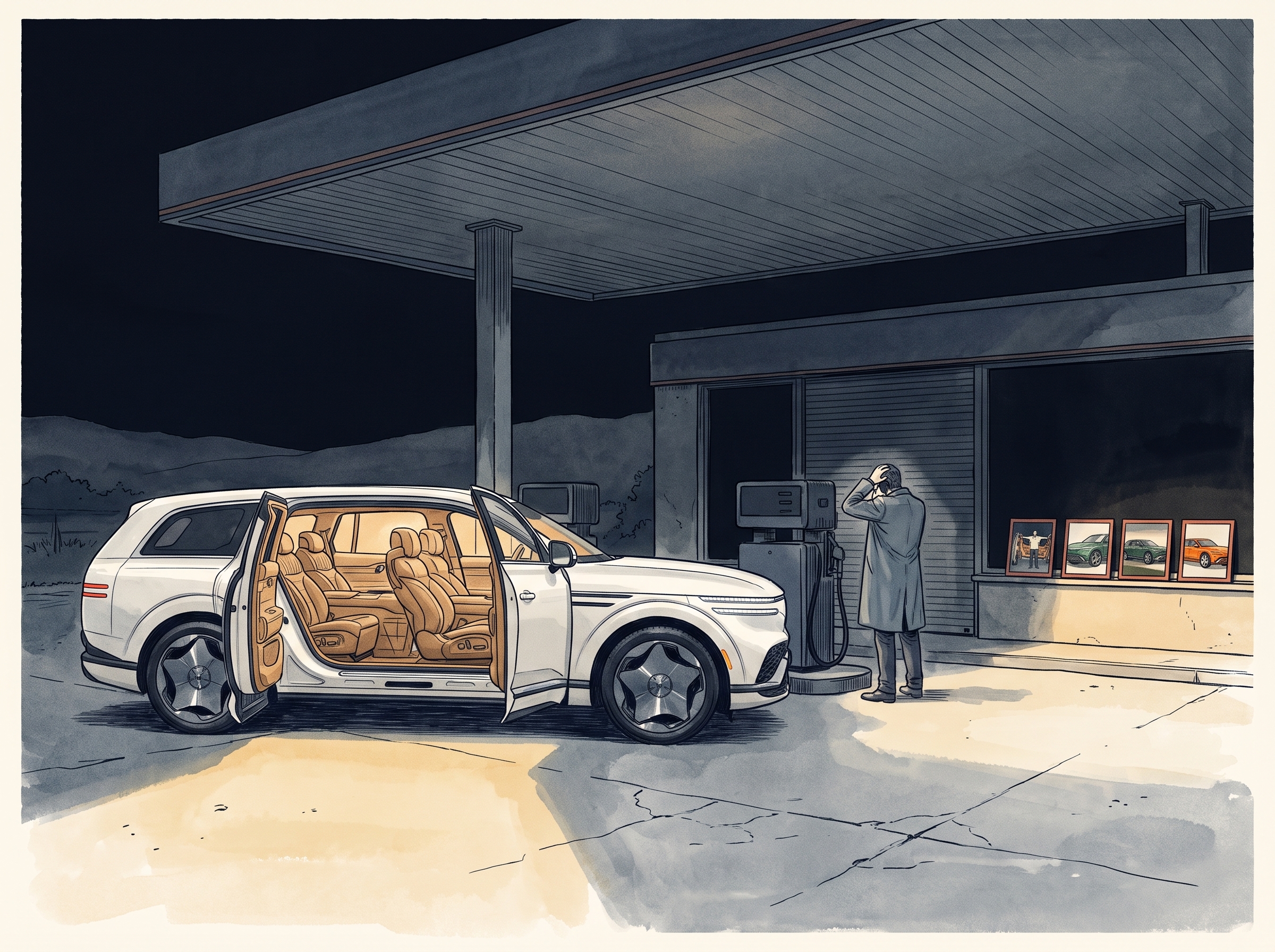
Ten years and a million cars in, Genesis finally has a flagship SUV — 208 inches long, pillarless coach doors, a body stiffer without its B-pillar than with one. The five reviewers at the San Francisco reveal agreed on that much. They also agreed, more quietly, on the range and the charging: adequate for the class, no better. For a car sold only as an EV, adequate raises a question none of them quite got round to asking.
The engineering is not in doubt
The Fast Lane Car spent its time on the part that matters most and photographs worst. The Neolun's rear doors carry the B-pillar inside them — 70-kilogram doors, cast-iron hinges in aluminium housings, 5 mm glass, triple seals — and the result, by Genesis's claim, is a shell 12 percent stiffer than the conventional car. "There's a reason we don't see a lot of vehicles without B-pillars," Roman noted, and then explained how the reason had been engineered away. The new EMP platform, the anti-propagation battery pack, the wireless BMS: all admired, all new to the group. What the video never gets to is a price, or who pays it.
The believers wish for more
Redline Reviews called it the car Genesis "desperately needed," and having climbed into a third row that fits a 5'7" adult with knees clear, found little to fault in the cabin. The reservation came elsewhere, and it came unprompted: "you can get vehicles in this class that have well over 400 miles of range." Car Confections, working the base car on a timed slot, reported 316 miles and 22 minutes and left the judgment to the EPA. Neither asked why a flagship launched with the group's largest-ever battery should land mid-pack on the number that battery exists to produce.
Twenty-two minutes, every time
A Auto Buyers Guide wasn't in the room, which freed Alex Dykes to read the spec sheet the way a buyer would. The 22-minute 10-to-80 claim, he pointed out, is what Hyundai quotes for nearly everything it builds, regardless of pack size — a house number, not a breakthrough — and the BMW, Volvo and Chinese competition will be quicker. No rear-drive long-range variant has been mentioned. No autonomy roadmap either. His open question was not about the car but the customer: the four-seat XC90 "just didn't sell well, especially in the United States," and Genesis has chosen to lead with a four-seat car.
The one who asked
Only Chasing Cars said it plainly. The GLS, the X7 and the Q9 will all still offer a V8, and "there's a big contingent of buyers that still want" one; electric-only "bucks a real trend." Tom Baker worked the 22 minutes back to a 219 kW average and called it "a little bit dated," then floated the range-extender he expects to follow. His answer to his own quarter-million-dollar question was telling: the GV90 makes sense as a bargain next to a Range Rover Autobiography, for buyers fed up with German build quality. The most incredible car Korea has produced, in his words — recommended on the grounds that someone else got worse.
the version of the GV90 with the coach doors is actually 12% stiffer than the version that has the B-pillar
I just wish this vehicle did have a little bit more range, but 316 is pretty comparable to the last Rivian R1S that I tested
Genesis might surprise us and have a starting price below $100,000, but we'll just have to wait and see
a lot of their vehicles regardless of battery pack charge in 22 minutes. Not quite sure why that's considered to be the secret sauce
could you ever consider spending a quarter of a million dollars on a South Korean luxury SUV?
The reviewers, side by side
5 reviewers. 2 questions. Where the arguments overlap and where they diverge.
A flagship needs numbers
The GV90 earns its milestone — real engineering in the pillarless body, the group's best cabin, a third row that finally works. But five reviewers looked at the only powertrain on offer, and four called it fine and moved on. Only Chasing Cars named the trend the car bucks, and even he landed on a bargain rather than a breakthrough. Genesis needs this car to sell, not just impress. Launched EV-only into a class where every rival still offers a V8, it has to win on range and charging — and on this slate of reviews, it doesn't.
The hard part was the engineering. The risky part was making it electric and nothing else.