Nissan Rogue
Nissan didn't build a better RAV4. It built a small locomotive
Thirteen reviewers drove prototypes up a Utah mountain against a RAV4 and came back with two ledgers: quieter and quicker on one side, thriftier and roomier on the other.
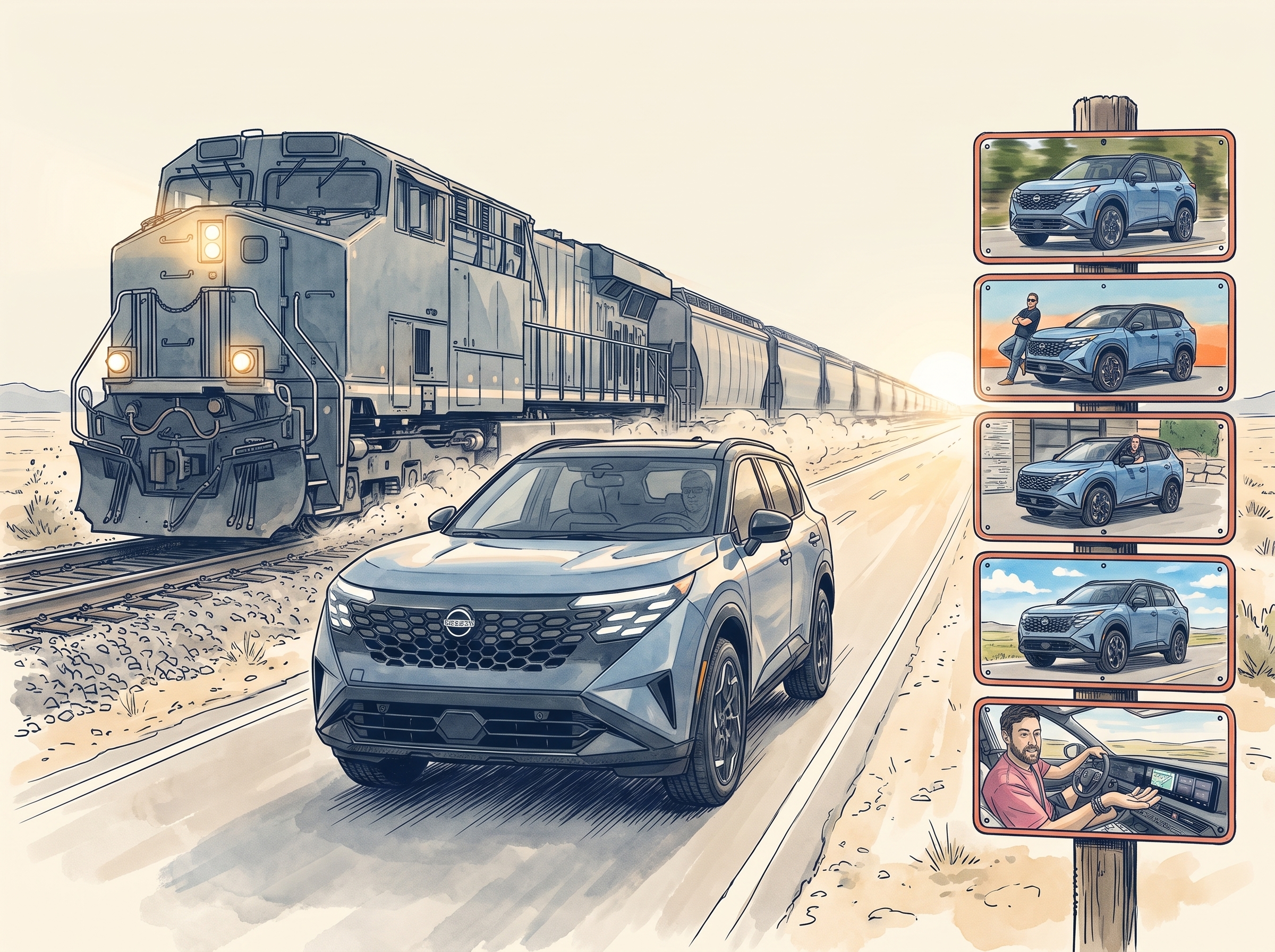
One of Nissan's engineers explained it to Brian Makse on the drive. Toyota built the RAV4 as a combustion car and then added electric motors; Nissan built the Leaf, then added an engine. The same brief, pursued from opposite directions. Nearly everything the thirteen cameras found during the Rogue Hybrid's launch week, what it does better than the Toyota and what it gives up, follows from that decision, and none of it happened by accident.
An EV carrying its own fuel
Nissan's spec sheet has a line for the transmission, and Makse noticed that the line is empty. A 1.5-litre turbocharged three-cylinder turns a generator and nothing else, while two electric motors do all the driving, the engine capped at 5,200 rpm, "which it has no particular reason to visit." Twenty minutes in an unfinished prototype and an hour in a nearly finished one left him with one verdict he was prepared to stand behind — "I drive them all. And this is the quietest" — and one reservation: the software that decides when the engine runs is the entire driving experience, and software is precisely what changes between a prototype and a showroom.
What the Rogue buys
A Auto Buyers Guide stated the trade in a single sentence — not more efficient than a RAV4, but more responsive, more consistent in "that EV type feel" — and then declared a side: "I'm willing to sacrifice some miles per gallon to get what I think is a better driving experience." Kirk Kreifels, who had both cars on the same hill, filled in the rest of the column. The Rogue climbed noticeably more quietly, steered better, sat better, and kept physical climate controls where Toyota had moved them into the touchscreen; standard all-wheel drive and one-pedal driving completed the list. Among the reviewers who drove the two back to back, none of this was in dispute.
What it spends
Car Confections did the arithmetic the others left undone. Against the car it replaces, the new Rogue gives up 8.2 cubic feet of cargo space and a couple of inches of rear legroom, leaving it five inches behind the CR-V, and Nissan's own 38 mpg combined sits below both the Toyota and the Honda. Real leather has gone, tri-zone climate has become dual-zone, and the price has risen. Edmunds Cars puts the entry point at about $37,000, "a few thousand dollars more than the RAV4, even when you account for having all-wheel drive," and the Platinum at $45,000. A worthy rival from behind the wheel, Edmunds concluded, before asking whether buyers would pay the difference: "we're not quite sure."
Where Toyota still answers
Kreifels' comparison carries a title promising that Nissan wins, and for most of the loop it delivers. Then he pins the throttle. "It's actually less responsive than Toyota's," he reports, because with no mechanical path from engine to wheels the generator must spin up before the motors receive their full ration, while the RAV4, waiting on nothing, simply goes. He closes the way an honest ledger closes — "I'm not saying that it is better than the RAV4 hybrid. It does a lot of things better" — with the Toyota still the king of the segment, and, in his words, for a reason.
The Rogue feels like what it is, which is an EV that carries its own fuel.
This one isn't more efficient than a RAV 4, but it's more responsive. It's more consistent in sort of that EV type feel.
Would I take a little bit of a louder acceleration to gain a few extra MPGs?
Now, will that resonate with consumers? We're not quite sure
I'm not saying that it is better than the Rav 4 hybrid. It does a lot of things better than the Rav 4 Hybrid
The reviewers, side by side
5 reviewers. 3 questions. Where the arguments overlap and where they diverge.
Two questions the hill left open
The ledger is fair as far as it goes, and it goes only so far. Series hybrids lose ground at a steady 75 mph, where the RAV4's mechanical link earns its keep; the question was asked on camera, but a mountain loop cannot answer it. And every impression came from a prototype — a mile each way for Kreifels, fifteen minutes for MotorWeek — on engine software Nissan has not finished. The trade-offs were chosen deliberately and delivered wherever a parking lot can show them. The interstate decides the rest.
Nissan chose a different set of trade-offs. The interstate has not voted yet.