Hyundai Tucson
The 2027 Tucson Copies Tesla's Screen and Keeps the Buttons
Six reviewers sat in Hyundai's redesigned compact SUV at its reveal, and five reached for the same comparison, meant as praise, for software seen only on a studio prototype.
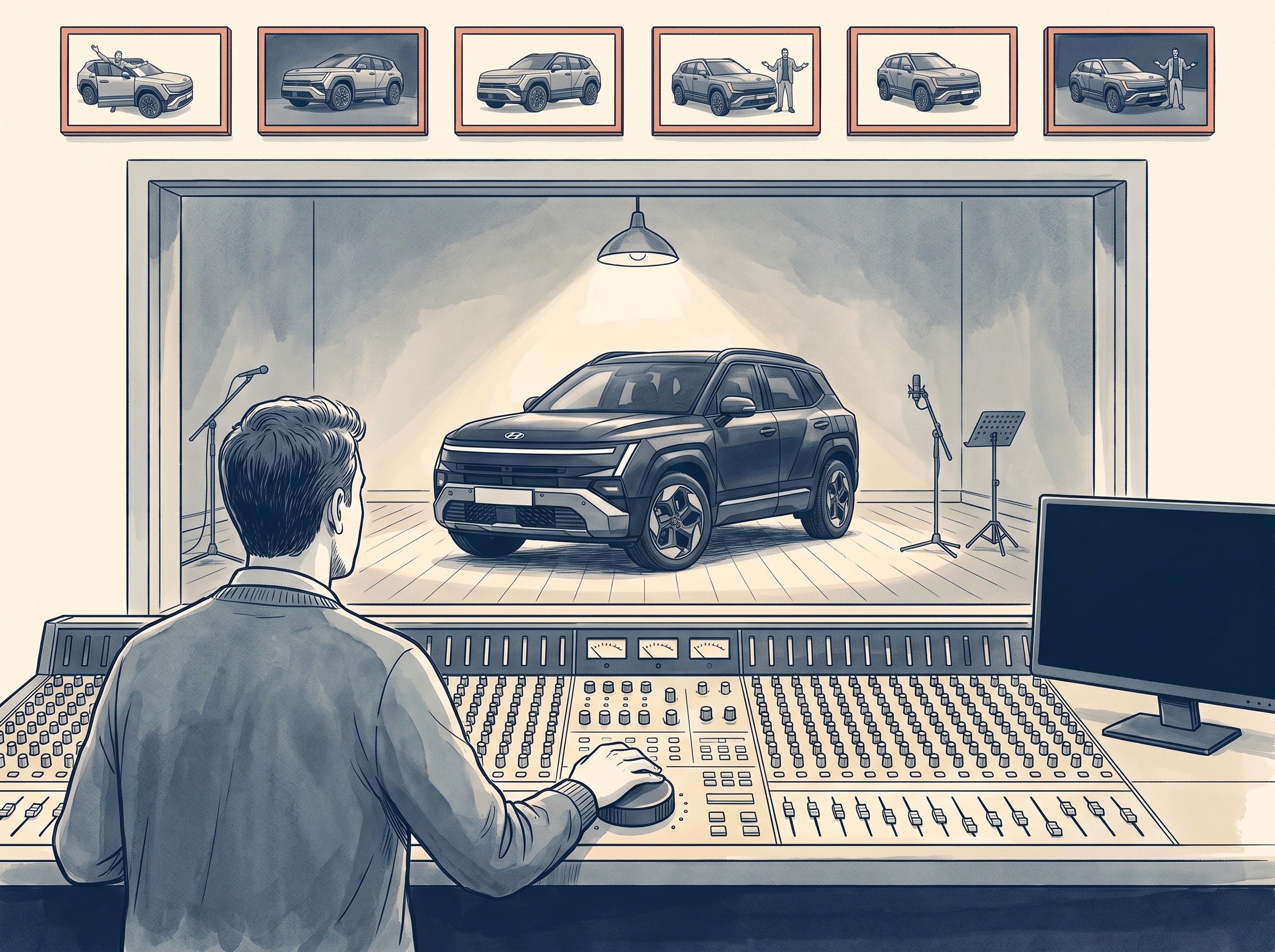
The 2027 Hyundai Tucson arrives with an optional 17-inch touchscreen and new software called Pleos, and five of the six reviewers gathered here compared it, unprompted, to a Tesla's. All five meant it as praise. Each then turned to the row of switches underneath — temperature, fan, seat heat, a volume knob, a tuning knob — that no Tesla carries, and saved the warmest words of the walkaround for those.
A familiar layout
Nobody had to squint to see it: vehicle status on the left, maps and apps on the right, a dock of favorites along the bottom. The Fast Lane Car called it "very much a Tesla-like setup" and found nothing to apologize for in the borrowing. Edmunds Cars noted that the Hyundai's screen outsizes a Model Y's and counted the likeness in its favor, while for Redline Reviews the 17-inch panel ranked as the biggest in the segment, with one concession — "Some may say that this is a little bit too big" — answered at once by pointing to the switches below. In all three accounts, the buttons arrived as the reassurance.
Best in class, provisionally
Kirk Kreifels went furthest. From the driver's seat he pronounced Pleos the fastest system he had seen, well ahead of Toyota's newest, and, tallying a preliminary score of 89 out of 100, marked the software "best in class." The same walkaround supplied its own footnotes: auto climate, sync and the heated steering wheel had moved into the screen, the vents had been pushed low to make room for it, and the voice assistant went untried for want of a phone signal in the studio. "I'm still learning how to do all this," he said, some minutes before the score.
The one who shrugged
Only TheStraightPipes made the comparison without making it a compliment. The screen looked larger than the job required — "this is kind of unnecessary" — and the settings kept unfolding: "there's so many more menus." Asked to lower a window, the Gleo assistant heard the request and refused it on safety grounds, then failed again by the voice button, in a prototype that had not been fully switched on. His summary: "You can't have a car in 2027 without something saying AI." Speed was granted freely: no lag, better than Volvo or Polestar at first glance. On Hyundai's own app store the doubt ran deeper, since somebody still has to write the apps.
What the dials are for
Autogefuhl, filming the European car, never mentioned Tesla at all. The software was traced instead to Kia's PV5 and PV7 vans, judged quicker than what came before, and named as the part of the car owners would need time with. His reassurance came from the same place as everyone else's, only stated more plainly: the manual dials remain, so the screen can be left alone, and phone mirroring remains too — "most of us will probably nowadays use that." No other voice on the panel said as directly what the buttons are for.
if you're going to copy somebody, Tesla's not a bad company to copy.
This similarity is not a downside by any means.
This reminds me so much of Tesla's infotainment software.
it's on par with probably Tesla, but I haven't driven a Tesla in a long time, so I don't want to say that.
This honestly kind of looks Tesla-ish, but like almost cartoonized, if that makes any sense.
it's still easy to control because you have these old-school physical dials. Then you don't have to use everything in here.
The reviewers, side by side
6 reviewers. 2 questions. Where the arguments overlap and where they diverge.
The buttons got the best reviews
Tesla asked its buyers to commit: no switchgear, everything through the glass. Hyundai took the layout and left the switches, the knobs and phone mirroring in place, which the panel read as the best of both. By the reviewers' own accounts, the praise fell on the parts that let a driver leave Pleos alone. Kirk Kreifels ranked the software first in class before the assistant had a signal; TheStraightPipes watched it refuse a window. Until Pleos has spent time on a road, only the switches have been fully tried.
Six reviewers, one giant screen, and the loudest thanks went to a volume knob.