Civic Type R EK9
The driver's benchmark in the hot hatch class. Six generations since 1997, one of the most committed FWD platforms ever built.
Where the Civic Type R starts — the Integra Type R recipe in a smaller, lighter three-door that Japan kept to itself.
10 reviewers · 26 videos · 3 hours watched · 52 press articles
Reviewers strongly agree on its performance and handling, but split on daily drivability.
across 10 reviewers

"it feels super comfortable riding in it right now... it's not going to give you a headache driving to the grocery store and back"
Capt Two6 · ▶ 12:08"The other downside with these older generation vehicles is that they clearly are not as optimized for larger drivers."
Jubbal & Cars · ▶ 5:40Performance
4.5/510 of 10 reviewersstrong consensus“That screamer of a B16B revs to looks like 8400 RPM. What a sound.”
positive · Zygrene · ▶ 5:07“It's a very special and characterful little engine. It's also handported and polished.”
positive · Jubbal & Cars · ▶ 2:13“the Civic car also managed to finish in the 15-second range... the Type R, which has an additional 15 horses has an earlier shift point that results in a 0.58 second difference over a 1/4 mile.”
positive · alancupra · ▶ 3:39Handling
5.0/510 of 10 reviewersstrong consensus“The DFE suspension has transformed this car. The damping is so much better now.”
positive · Zygrene · ▶ 7:00“it feels so planted and balanced throughout each of these corners”
positive · Clay Wong · ▶ 8:45“It has better high speed cornering capabilities, the Civic R. Its very stable, doesn’t do any unnecessary moves.”
positive · miroshi · ▶ 8:55Fun to drive
5.0/510 of 10 reviewersstrong consensus“The beauty of this Type R, unlike the new Type Rs, is that you can have fun at lower speeds.”
positive · Zygrene · ▶ 11:52“This is what I miss from modern Hondas. You had this sense of theater and what Honda was doing back then.”
positive · Jubbal & Cars · ▶ 19:57“I really want one now it's it's weird enough that people would be like what the hell is that guy doing if he's driving by himself if it's slower but right-and drivve and rare I think it's cooler and better”
positive · TheStraightPipes · ▶ 15:13Daily drivability
3.0/510 of 10 reviewerssplit“the bolsters here for my thighs are about an inch too narrow. So, it's kind of pinching me into the seat.”
mixed · Zygrene · ▶ 3:58“The other downside with these older generation vehicles is that they clearly are not as optimized for larger drivers.”
critical · Jubbal & Cars · ▶ 5:40“it feels super comfortable riding in it right now... it's not going to give you a headache driving to the grocery store and back”
positive · Capt Two6 · ▶ 12:08Value
4.0/510 of 10 reviewersconsensus“at 30,000... you're getting an absolute bargain in terms of pure driving Dynamics”
positive · Zygrene · ▶ 17:27“if you are chasing driving experience more so than just outright performance, it's really hard to argue with these cars.”
positive · Jubbal & Cars · ▶ 16:47“The price is less than 2 million yen. We definitely want you to drive it.”
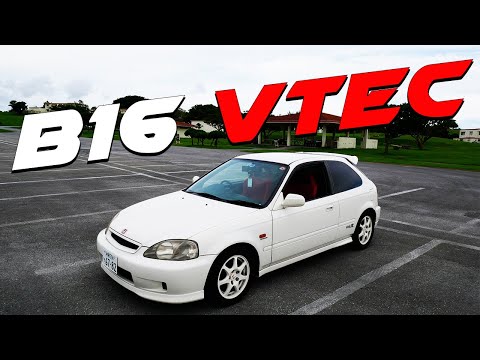
positive · miroshi · ▶ 13:41The EK9 is where the Civic Type R starts. Honda launched it in Japan in August 1997, a three-door on the sixth-generation Civic and the third car to carry the badge after the NSX and the DC2 Integra. It was never sold new anywhere else, so every figure here is the Japanese-market one.
Mechanically, it is built around the B16B: a 1.6-litre twin-cam VTEC with a hand-ported head and high-compression pistons, good for 185 PS at 8,200 rpm. That is 116 PS per litre, which Honda claimed at launch as the highest of any naturally aspirated production engine. It drives through a close-ratio five-speed and a helical limited-slip differential.
The shell got as much work as the engine. It was seam-welded for stiffness, the sound deadening was left out, and the suspension is double wishbones at both ends with shorter springs, stiffer dampers and thicker anti-roll bars.
The facelift came with cars built from August 1998: a wider grille, brake cooling ducts in the bumper, and Sunlight Yellow alongside Championship White.
Where it places in the lineage: this is the template. A small high-revving engine, a manual gearbox, a proper differential and weight taken out. The EP3 that replaced it moved to a 2.0-litre K-series, six speeds and a strut front end.
Hear it in the reviewer’s words




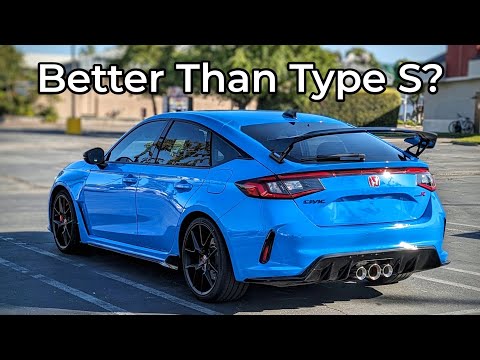

- Top Gear
Big UK road test: new Honda Civic Type R Reviews 2026 | Top Gear
◆Worth itA serious, highly effective cross-country device that trades traditional VTEC character for turbocharged speed and track-ready precision.
- Best for
- Enthusiasts who prioritize track-day capability and raw speed over subtle styling.
- Watch out
- Excessive tyre roar · Polarizing, ostentatious exterior design · Rigid +R mode is too harsh for public roads · High seating position
1,886 wordsOpen articleQuotes worth your time - Top Gear
Honda Civic Type R review: the first UK test Reviews 2025 | Top Gear
◆BuyThe new Civic Type R is a masterclass in hot hatch engineering, combining ruthless performance with newfound daily refinement.
- Best for
- Enthusiasts who need a daily driver that can handle track work and rough roads.
- Watch out
- Aggressive, polarizing styling · Functional but busy aero design
1,524 wordsOpen articleQuotes worth your time - Top Gear
First Drive: Honda Civic 2.0 VTEC Turbo Type R GT Reviews 2026 | Top Gear
◆Worth itDespite reservations about its polarizing styling, the Civic Type R is a massively fast, highly capable, and genuinely exciting hot hatch that carves out its own unique niche.
- Best for
- Enthusiasts who prioritize track-ready performance and mechanical engagement over understated aesthetics.
- Watch out
- Polarizing, aggressive exterior styling · Excessive tyre roar on coarse surfaces · Turbo lag at low RPM · Stiff ride quality · Limited steering wheel adjustment due to dash layout
2,524 wordsOpen articleQuotes worth your time - Top Gear
Honda Civic Type R Sport Line review: the wingless, ‘subtle’ super-hatch Reviews 2026 | Top Gear
◆Worth itDespite the questionable 'subtle' styling tweaks, the Civic Type R remains a world-class driver's car that is now slightly more usable on public roads.
- Best for
- Enthusiasts who want a world-class driving experience and prefer a slightly less aggressive aesthetic.
- Watch out
- Poor infotainment system · Clashing interior color scheme · Limited availability due to factory closure
1,468 wordsOpen articleQuotes worth your time - Top Gear
Honda Civic Type R (2017-2021) Driving, Engines & Performance | Top Gear
◆Worth itThe FK8 Civic Type R is a masterclass in front-wheel-drive performance, offering a perfect balance of track-ready precision and daily usability.
- Best for
- Enthusiasts who want a high-performance daily driver that excels on a track.
- Watch out
- Performance can be difficult to fully exploit on public roads · Less playful than some rivals at low speeds
1,100 wordsOpen articleQuotes worth your time - Top Gear
Honda Civic Type R review: mad 316bhp hot hatch tested Reviews 2026 | Top Gear
◆BuyThe new Civic Type R is a masterclass in front-wheel-drive performance, successfully blending track-day intensity with daily usability.
- Best for
- Enthusiasts who want a highly capable track car that can also handle the daily commute.
- Watch out
- Disjointed interior design · Dated infotainment graphics · Lack of pedal feel at the top of the brake travel
1,677 wordsOpen articleQuotes worth your time - Top Gear
Honda Civic Type R Interior Layout & Technology | Top Gear
◆Worth itThe Civic Type R offers an exceptional driver-focused cockpit and impressive practicality, though it is let down by dated infotainment graphics and some cost-cutting in the rear cabin.
- Best for
- Enthusiasts who need a daily driver that can also handle family duties.
- Watch out
- Dated infotainment graphics · Cheap-looking shift-up lights · Basic rear passenger area · No rear armrest
892 wordsOpen articleQuotes worth your time - Top Gear
Honda Civic Type R Driving, Engines & Performance | Top Gear
◆Worth itThe Civic Type R is a masterclass in front-wheel-drive engineering, offering a perfect blend of daily comfort and track-focused precision.
- Best for
- Enthusiasts who want a manual, front-drive hot hatch that is as usable on the commute as it is rewarding on a B-road.
- Watch out
- road noise at cruise · traction limitations in wet weather
1,253 wordsOpen articleQuotes worth your time - Top Gear
Honda Civic Type R (2017-2021) Review 2026 | Top Gear
◆Worth itThe FK8 Civic Type R is a spectacular, engineer-focused hot hatch that stands as a pinnacle of its era.
- Best for
- Enthusiasts who prioritize driving precision and mechanical engagement over subtle styling.
- Watch out
- Divisive, aggressive styling · Limited Edition model is highly collectible and expensive
1,337 wordsOpen articleQuotes worth your time
- Motor Sports edition (1998)Stripped base for competition use: steel wheels, no air conditioning, no power windows.
- Type Rx (1999)The comfort-equipped car for the final model year: CD player, power windows, electric folding mirrors, automatic air conditioning, keyless entry.
Japan-only — never sold new in any other market, so every car elsewhere is a private import and all figures are Japanese-market. Quoted kerb weight runs from 1,050 to 1,070 kg depending on year and equipment. Sound deadening was left out at the factory. Cars built from August 1998 are the facelift: a wider grille, brake cooling ducts in the front bumper, and Sunlight Yellow added to the colour list.